

Bar-end mirrors change your rear view, your bike's width and its look. Here's which FENRIR set to buy, how to fit it, and how to stop it vibrating.
October 23, 2026 · 12 min read

TL;DR
A bar-end mirror moves the mirror outward and down, and it shifts three things at once: what you see behind you, how wide the bike is at the bars, and how the front end looks. Buy the -E version if the E-mark is checked where you ride, and check your own local rules before you assume any mirror is compliant.
What bar-end mirrors actually change
A bar-end mirror bolts to the end of the handlebar instead of sitting on a stalk above it. That one change moves the mirror outward and down, and it shifts three things at once: what you can see behind you, how wide the bike is at the bars, and how the front end of the bike looks.
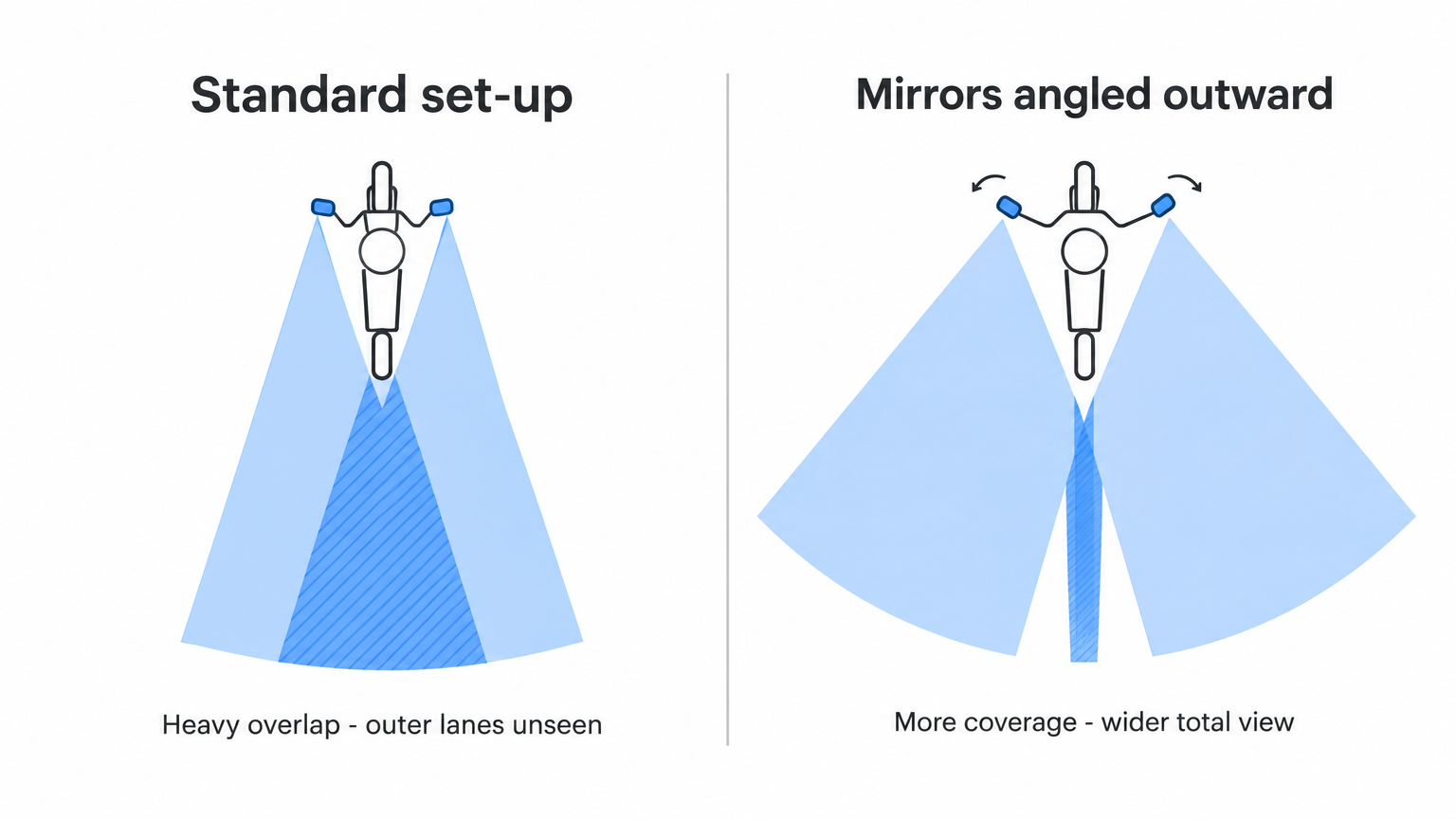
The visibility point is the one people get wrong. Most riders set their mirrors so the left one shows roughly the same scene as the right, which wastes half your rear view on duplicated image. FENRIR's own note on correct mirror use makes the case for tilting each mirror outward instead, so the left mirror covers the lane on your left and the right expands the view on your right, with only a small overlap in the middle. Bar-end mirrors make that outward angle easier to reach, because the mirror already sits at the edge of the bar.
The width point cuts the other way. A bar-end mirror sticks out past the grips, so your bike is wider at exactly the height where you filter between cars. That is worth knowing before you buy, not after.
Bar-end vs stock mirrors: the honest trade-off
Here is the comparison we would give a friend, based on what bar-end owners actually report rather than the marketing line.
| Stock stalk mirrors | Bar-end mirrors | |
|---|---|---|
| Field of view | Wide, but half of it is often shoulders or duplicated image | Narrower mirror area, but once angled outward you often see more of the lane behind you |
| Vibration | Damped by a long stalk and factory bar-end weights | More exposed; can vibrate at speed unless the bar end is weighted and the screws are locked |
| Bike width | Sits above the grips | Sticks out past the grips, which matters when filtering |
| Look | Functional, OEM | The cafe-racer / naked-bike look most buyers are after |
| Fitment | Universal | Needs the right bar-end adapter for your bar |
The trade-off in one line: you swap some mirror area and a bit of width for a cleaner look and, once set up right, a more useful rear view. The set-up is where it goes wrong, and that is the part worth getting right.
Are bar-end mirrors legal where you ride?
This is the question the product page answers badly, so it is worth untangling. Mirror rules are set per country, and they fall into two buckets: whether mirrors are required at all, and whether the ones you fit carry the right approval marks.
On the first bucket, the UK is a useful example because riders there have tested it. The consensus in MotoUK threads is that there is no legal requirement to have mirrors fitted at all, but if mirrors are fitted they must be in good, usable condition to pass an MOT (r/MotoUK threads, search-derived).
On the second bucket, the mark that matters in Europe is the E-mark, and FENRIR sells two versions of the same mirror for exactly this reason. The standard forged bar-end mirror, 801-0372, is $79 and is not E-marked. The homologated twin, 801-0372-E, is $100 and carries the E-mark. The -E suffix is FENRIR's signal for homologation across the range, which is why you also see it on the 801-0375, 801-0378 and 801-0500 models.
| The question | What actually decides it |
|---|---|
| Must I fit mirrors at all? | Country-specific. In the UK, riders report no legal requirement to have mirrors, but any fitted must be in good, usable condition to pass an MOT (r/MotoUK, search-derived) |
| Do they need an approval mark? | In Europe, yes: the E-mark. That is the whole reason the -E version exists |
| Which one do I order? | The -E version wherever the E-mark is checked, regardless of "street legal" wording on a base page |
| What to watch for | The 801-0374 page's "street legal" copy contradicting its own Emark: No spec block |
How to fit bar-end mirrors
FENRIR's installation guide is an adapter picker: you click your model number and get that bike's steps, because the method shifts from bike to bike. Across all of them, the same sequence shows up.
- Confirm the bar is hollow. The universal adapters need a hollow bar end with a 13-19 mm inner diameter. If you are using a bike-specific adapter, this step is already solved for you.
- Deal with the original bar-end weight. On most bikes you remove it and mount the mirror in its place. On some (the Kawasaki 801-0374 fitment, for instance) you remove the weight, add the mirror plus 1 washers, then refit the weight. Keeping weight in the bar end is what protects you against the vibration problem above.
- Clear the throttle grip. The common snag is the mirror bracket catching the throttle grip, so the grip will not return freely. The fix is a shim or washer behind the right throttle grip to open a gap, or trimming a little of the excess grip.
- On some models, work inside the bar. For several Yamaha, Kawasaki and Honda models FENRIR gives a "Plan 1 / Plan 2" choice: remove the rod inside the handlebar and push it deeper, leaving a 4-5 cm gap at the bar end, then use the expansion-sleeve method. Plan 1 keeps the factory state as far as possible.
- Fit, angle, and lock. Mount the mirror, set it outward rather than square behind you, and put thread-locker on the screws before you tighten. FENRIR's own guidance is to use low-strength screw glue on the accessory screws to add rigidity and cut vibration (FENRIR FAQ).
Try FENRIR Motorcycle
The whole point of a bar-end mirror is that it turns a part you tolerate into a part you notice: cleaner lines at the bars, a rear view aimed where you actually ride, and a set that stops shaking once you have weighted it and locked it down. FENRIR builds the mirror, the adapter and the plug as one system, which is why the fitment number matters more here than the sticker price.
If you are ready to fit a set, start with the motorcycle mirror collection, match the adapter to your bike before anything else, and choose the -E version if the E-mark is checked where you ride.
Frequently Asked Questions
What are bar-end mirrors, and do they actually work?
Bar-end mirrors bolt to the end of the handlebar instead of sitting on a stalk above it, which moves them outward and down. Once angled outward and fitted with weight kept in the bar end, they often give a clearer rear view than the factory stalks, because the left mirror covers your left lane and the right expands your right. FENRIR builds its range around this system, so the mirror, adapter and hole plug come as matched parts.
What do I need to buy for a FENRIR bar-end mirror set?
Two things: the mirror unit, an adapter matched to your bike's bar end.
Are bar-end mirrors legal where I ride?
It depends on your country, so check your own local rules. Mirror rules split into whether mirrors are required at all and whether the ones you fit carry the right approval marks; in Europe the mark that matters is the E-mark, which is why FENRIR sells a homologated -E version of its mirrors. Note that the 801-0374 product page carries "street legal" copy while its spec block reads Emark: No, so order the -E version if the E-mark is checked where you ride.
0 ความคิดเห็น